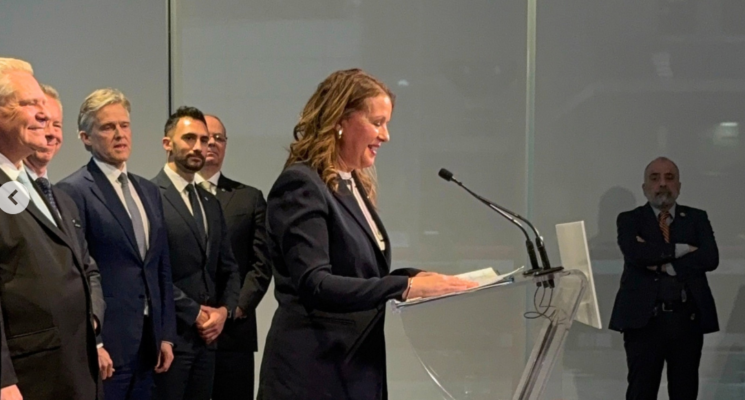
January 23, 2026: Ontario Ready to Take Bid to Host Defence, Security and Resilience Bank to the World
Good afternoon, everyone.
I’m Julie Dzerowicz, Member of Parliament for Davenport, Chair of Toronto Caucus — representing 23 federal Liberal MPs — and Chair of the Canada-NATO Parliamentary Association.
When we were last together in December, I spoke about why the DSRB matters. Today, I want to talk about why this moment matters — and why Toronto is Canada’s strongest bid.
Earlier this week at Davos, Prime Minister Carney said something that resonated deeply with me. He said: “The old order is not coming back. We should not mourn it. But from the fracture, we can build something better, stronger, and more just.”
He also said that Canada is no longer relying on just the strength of our values — but on the value of our strength. We’re building that strength at home: cutting barriers, fast-tracking investment, doubling defence spending by 2030, and committing to reach 5 percent of GDP by 2035 — the most ambitious defence build-out in Canadian history.
The DSRB is how we turn that commitment into action. This bank is how allied democracies stop talking about rearming and start financing it — credibly, at scale, and with the discipline that capital markets demand.
Now, let me be clear about something: I’m here representing Toronto Caucus — 23 Liberal MPs — not the federal government. The Prime Minister will make the final call. But our job today is to make that decision as easy as possible.
And here’s the simple truth: The DSRB is a bank. Not a policy shop. Not a think tank. A bank.
Banks need capital markets. Toronto is North America’s second-largest financial centre. All five of Canada’s major banks are headquartered here — including RBC, which is already a founding institutional partner of the DSRB. We have the pension funds, the institutional investors, the regulatory infrastructure, and the workforce. Over 450,000 financial services professionals work in this region.
Banks need global connectivity. Pearson serves nearly 200 destinations. We have 100 consular missions. Half our residents are foreign-born. We don’t just talk about diversity — we operate in it every day.
And banks need trust. Canada’s banking system has been ranked among the world’s soundest for over a decade. As Kevin Reed put it: “Canada is viewed very much like the honest banker.” In a world where trust is increasingly scarce, that reputation is priceless.
A month ago, I told you this was Canada’s moment to lead. That hasn’t changed.
What has changed is the world around us. Since December, the geopolitical landscape has only grown more uncertain. Our allies are looking for partners they can count on — and Canada, under Prime Minister Carney’s leadership, has made clear we intend to be one of them.
Toronto is ready.
I spent almost twenty years in banking before I entered politics. I learned one thing above all else: ambition isn’t enough. You need infrastructure, talent, and a financial ecosystem that can sustain complexity over the long term.
Toronto has all three. Under the leadership of Toronto Global and with support from the Province, the City, and business leaders across the region, a 120-page pitch book was assembled — with letters of support from Premier Ford, Mayor Chow, and the CEOs of CIBC, Sun Life, Manulife, OMERS, Ontario Teachers’, CPPIB, and dozens more. Because this isn’t about one city winning — it’s about Canada succeeding.
So here’s what I’ll leave you with:
Prime Minister Carney said that for middle powers, the question isn’t whether to adapt to this new reality — we must. The question is whether we adapt by building higher walls, or by building something more ambitious.
The DSRB is our chance to build something more ambitious — together with our allies. And Toronto is where we will build it.
Thank you.
December 17, 2025: Ontario’s Bid to Host the Defence, Security and Resilience Bank to the World
At TMX Group, Toronto
Good afternoon, and thank you for joining us here at the TMX Group—the heart of Canada’s capital markets.
I’m Julie Dzerowicz, Member of Parliament for Davenport, Chair of Toronto Caucus representing 23 federal Liberal MPs across this city, and Chair of the Canada-NATO Parliamentary Association. [acknowledge colleagues in the audience]
I’m honoured to stand alongside Premier Ford and Mayor Chow to make a bold statement: Toronto should be the home of the Defence, Security and Resilience Bank – will refer to as DSRB.
Before I entered politics a decade ago, I spent almost twenty years in the private sector—in investment banking, banking and biotechnology. At the Bank of Montreal, I was a key leader on the team that helped launch Canada’s email money transfer service—the kind of financial innovation that put Canadian banking on the global map.
I tell you this because I understand what it takes to build something transformational from the ground up. And the DSRB is exactly that kind of once-in-a-generation opportunity.
Why does this bank matter?
NATO Secretary General Mark Rutte has been unequivocal: “We can’t afford to wait. We are safe now, but we are not safe in five years.”
All NATO countries (including Canada) has committed to investing 5 per cent of GDP in defence and security by 2035. That means NATO nations will need to mobilize hundreds of billions of dollars—not just in military hardware, but in the financial architecture to support it.
As Rob Murray, the CEO of the DSRB Development Group and NATO’s former Head of Innovation, put it: “For too long, we have underestimated the role of capital in defence. The banks stepping up today understand that deterrence demands financial support.”
Kevin Reed, the bank’s President, said it directly when he testified before our Industry Committee last month: “This is Canada’s time to lead in NATO and with our allies in defence finance.”
I couldn’t agree more.
Why Toronto?
Toronto is North America’s second-largest financial centre after New York. All five of Canada’s Big Five banks are headquartered here—Royal Bank, TD, Scotiabank, BMO, and CIBC—holding over two trillion dollars in assets.
RBC is already a founding institutional partner of the DSRB, standing alongside JPMorgan, ING, and Commerzbank. That’s not an accident. It’s a testament to the quality and stability of Canadian banking.
Canada’s banking system has been ranked among the world’s soundest for more than a decade. In an era of economic uncertainty, that matters.
Toronto offers unmatched global connectivity—Pearson International Airport serves nearly 200 destinations. We’re home to 107 consular missions and more than 190 languages are spoken here. We have the workforce, the infrastructure, and the international reach that a global institution like the DSRB requires.
What does this mean for Canadians?
Hosting the DSRB headquarters in Toronto could create approximately 3,500 high-value jobs in defence finance.
But more than that, it would position Canada as the global hub where member nations convene—elevating Toronto to the same tier as London and New York when it comes to multilateral financial institutions.
Prime Minister Carney has made clear that Canada is rebuilding, rearming, and reinvesting. In June, he announced that Canada would meet NATO’s 2 per cent target this fiscal year—half a decade ahead of schedule—and commit to 5 per cent by 2035.
That’s not just about meeting an obligation. As the Prime Minister said: “If we want a more secure world, we need a stronger Canada.”
Hosting the DSRB would ensure that as we ramp up defence spending, we’re also building Canada’s capacity to finance and support those investments—here at home, creating good Canadian jobs.
Why now?
The world is watching. The DSRB will choose its headquarters location in the coming months. Up to 40 nations will become shareholders. Twelve anchor countries will ratify the founding charter.
Canada has a choice: We can participate, or we can lead.
Premier Ford, Mayor Chow, and I—along with hundreds of supporters from across the financial services, defence, manufacturing, and academic sectors—are here today to say: Canada should lead. And Toronto is ready.
Thank you.